
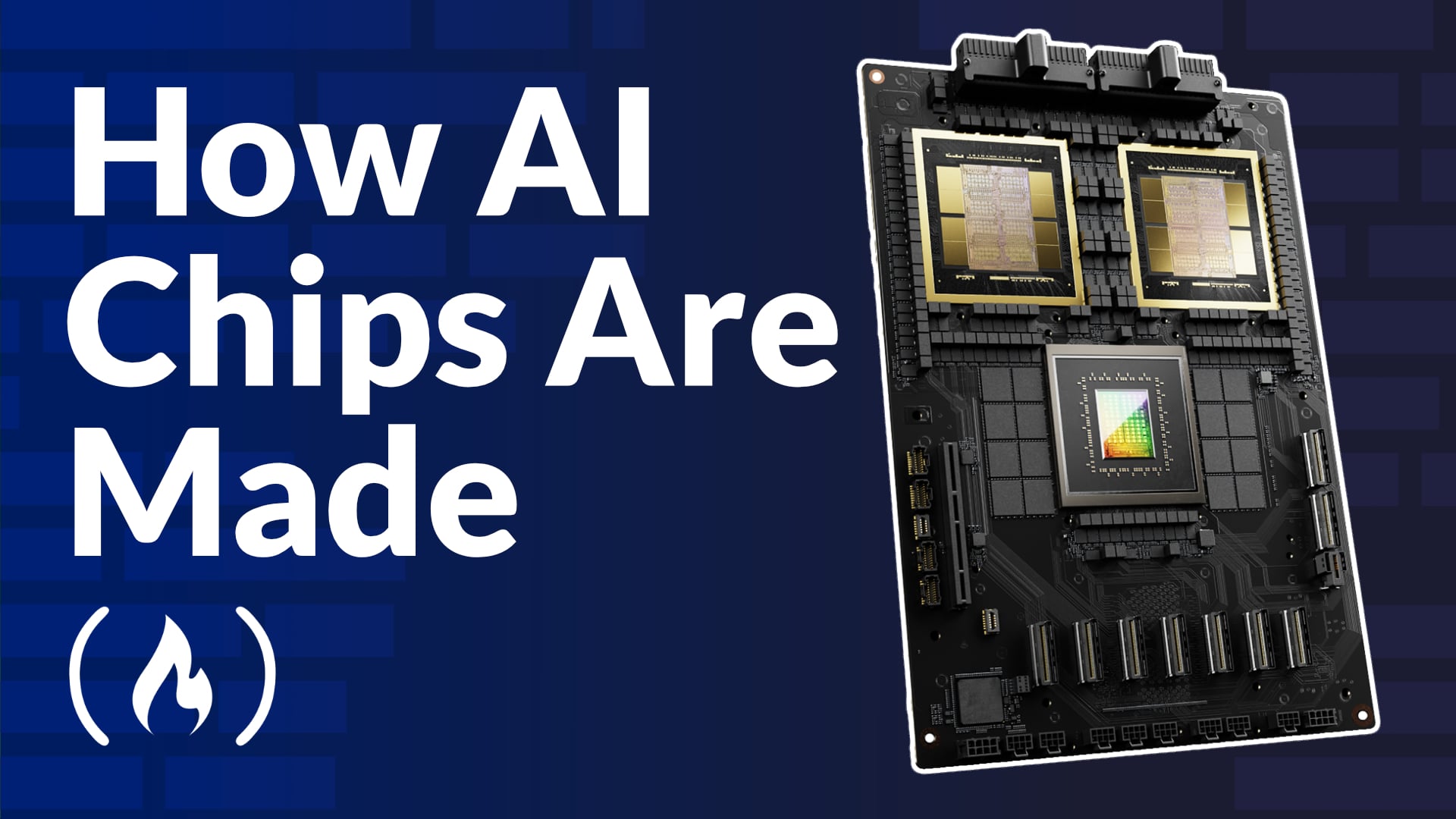
We just published a comprehensive, first-principles course on the semiconductor supply chain on the freeCodeCamp.org YouTube channel. Taught by hardware specialist Kian Kyars, this deep dive explains the complex journey of an AI accelerator from raw silicon all the way to modern data center deployment.
As capital expenditure on AI infrastructure increases into the hundreds of billions, hardware is no longer a niche topic reserved only for chip architects. Understanding the physical machinery running modern models has become important for developers, researchers, and tech professionals alike.
The course focusses on Nvidia's latest hardware, tracing how a dual-die GB300 Blackwell Ultra GPU is designed, fabricated, packaged, and networked. Across six structured modules, Kian breaks down:
Semiconductor Physics & Scaling
How planar, FinFET, and Gate-All-Around (GAA) architectures work, why GPUs run at lower clock frequencies than CPUs, and how the end of Dennard scaling altered processor design.Design & EDA
The step-by-step pipeline converting Register-Transfer Level (RTL) code into manufacturable mask sets using electronic design automation toolchains like Synopsys, Cadence, and Siemens EDA.Fabrication & Cleanrooms
The mechanics inside leading-edge fabs like TSMC, wafer handling, high-purity North Carolina quartz, and the math behind Poisson defect yield models.Lithography & Equipment
How ASML’s extreme ultraviolet (EUV) scanners bounce 13.5 nm light off atom-flat Carl Zeiss mirrors to pattern features just nanometers wide.Memory & Advanced Packaging
High Bandwidth Memory (HBM3E/HBM4) integration, Through-Silicon Vias (TSVs), and TSMC’s CoWoS-L packaging that binds compute dies together.Rack-Scale Systems & Geopolitics
Scale-up NVLink fabrics, 135 kW power boundaries, export restrictions, and critical single-point-of-failure choke points across the global ecosystem.
You can watch the full course for free on the freeCodeCamp.org YouTube channel (3-hour watch).


